
Fluid mechanics is not a narrow subject taught in isolation. It underpins the foundations of Mechanical, Civil, and Chemical Engineering, influencing everything from water infrastructure and energy systems to industrial processing and environmental protection.
That is precisely why The Armfield Fluid Mechanics apparatus range is essential for engineering education across disciplines, covering the full curriculum for Mechanical, Civil, and Chemical Engineering. It includes topics such as hydrostatics, fluid dynamics, open channel flow, flow around bodies, compressible flow, and rotodynamic machines.
This is not just a marketing statement—it reflects how our equipment is structured, modular, and aligned with real university syllabi worldwide.
A complete solution, not isolated experiments
One of the challenges educators often face is fragmented laboratory setups—equipment that demonstrates one principle well but fails to connect with the wider curriculum. At armfield, we approach fluid mechanics as a complete learning journey.
Our solution offers a full ecosystem of fluid mechanics apparatus, allowing institutions to build laboratories that grow with their courses. Whether students are learning introductory hydrostatics or exploring advanced rotodynamic machines, the transition between experiments feels logical and cohesive.
Once again, this is why The Armfield Fluid Mechanics range is essential for engineering education across disciplines, covering the full curriculum for Mechanical, Civil, and Chemical Engineering. It includes topics such as hydrostatics, fluid dynamics, open channel flow, flow around bodies, compressible flow, and rotodynamic machines.
Hydrostatics and fundamental principles
Hydrostatics forms the starting point for any serious study of fluid mechanics. Our hydrostatics fluid mechanics apparatus allows students to visualise pressure variation, buoyancy, and force measurement in a controlled and repeatable manner.
These experiments help learners bridge the gap between equations on a page and physical behaviour in real systems—an essential step in building engineering intuition.
Fluid dynamics brought to life
Understanding fluid dynamics is critical for applications such as pipe networks, HVAC systems, and industrial transport processes. Our fluid dynamics trainers enable students to explore laminar and turbulent flow, losses in pipes, and energy transfer using real data acquisition.
This practical engagement reinforces why The Armfield Fluid Mechanics range is essential for engineering education across disciplines, covering the full curriculum for Mechanical, Civil, and Chemical Engineering. It includes topics such as hydrostatics, fluid dynamics, open channel flow, flow around bodies, compressible flow, and rotodynamic machines.
Open channel flow for civil and environmental engineers
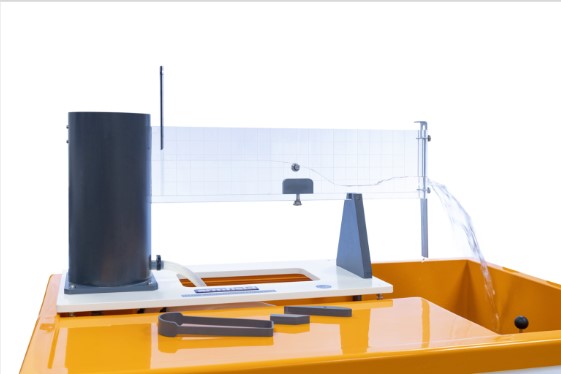
For Civil and Environmental Engineering programmes, open channel flow is non-negotiable. Our open channel fluid mechanics apparatus enables detailed study of flow regimes, hydraulic jumps, weirs, and flumes—concepts that are central to river engineering, flood management, and water resources planning.
Students gain practical exposure to real-world hydraulic behaviour, preparing them for professional practice rather than purely theoretical understanding.
Flow around bodies and aerodynamic insight
Flow around bodies is fundamental for understanding drag, lift, and wake formation. Through wind tunnels and flow visualisation equipment, students can directly observe how fluids interact with solid surfaces.
This area is particularly valuable for Mechanical and Aerospace Engineering pathways, where experimental observation complements numerical simulation and theory.
Compressible flow and advanced applications
Compressible flow can be challenging to teach without the right tools. Our compressible flow fluid mechanics apparatus supports the study of nozzle flow, shock waves, and high-speed gas behaviour—topics essential for advanced mechanical and chemical engineering courses.
With safe, well-instrumented systems, students can explore complex phenomena with confidence and clarity.
Rotodynamic machines and real engineering systems
Rotodynamic machines—such as pumps, fans, and turbines—are everywhere in industry. Our dedicated rigs allow students to measure performance curves, efficiency, and operational limits using industrially relevant equipment.
This practical experience reinforces why The Armfield Fluid Mechanics range is essential for engineering education across disciplines, covering the full curriculum for Mechanical, Civil, and Chemical Engineering. It includes topics such as hydrostatics, fluid dynamics, open channel flow, flow around bodies, compressible flow, and rotodynamic machines.
Designed for teaching excellence and EEAT standards
As a company deeply embedded in engineering education, armfield works closely with academics to ensure our equipment meets modern teaching expectations and aligns with Google’s EEAT principles:
- Experience – Built from decades of collaboration with educators worldwide
- Expertise – Developed by engineers for engineers
- Authoritativeness – Trusted by leading universities and research institutions
- Trustworthiness – Robust design, clear documentation, and long-term support
Our laboratories are not just technically accurate; they are designed to help educators deliver genuinely helpful, engaging, and outcome-focused learning experiences.
One partner for all your fluid mechanics needs
If you are planning a new laboratory or upgrading existing facilities, having a single, reliable partner matters. At armfield, we provide a complete solution for all types of fluid mechanics apparatus, supported by expert advice, training, and long-term technical support.
That is why institutions across the world continue to choose us when delivering comprehensive fluid mechanics education.
Ready to elevate your fluid mechanics laboratory?
If you are looking to equip your students with practical, industry-relevant skills and want a solution that truly covers the full curriculum, we would love to help.
